
Article: What Happens to a Razor Blade After the Shave?
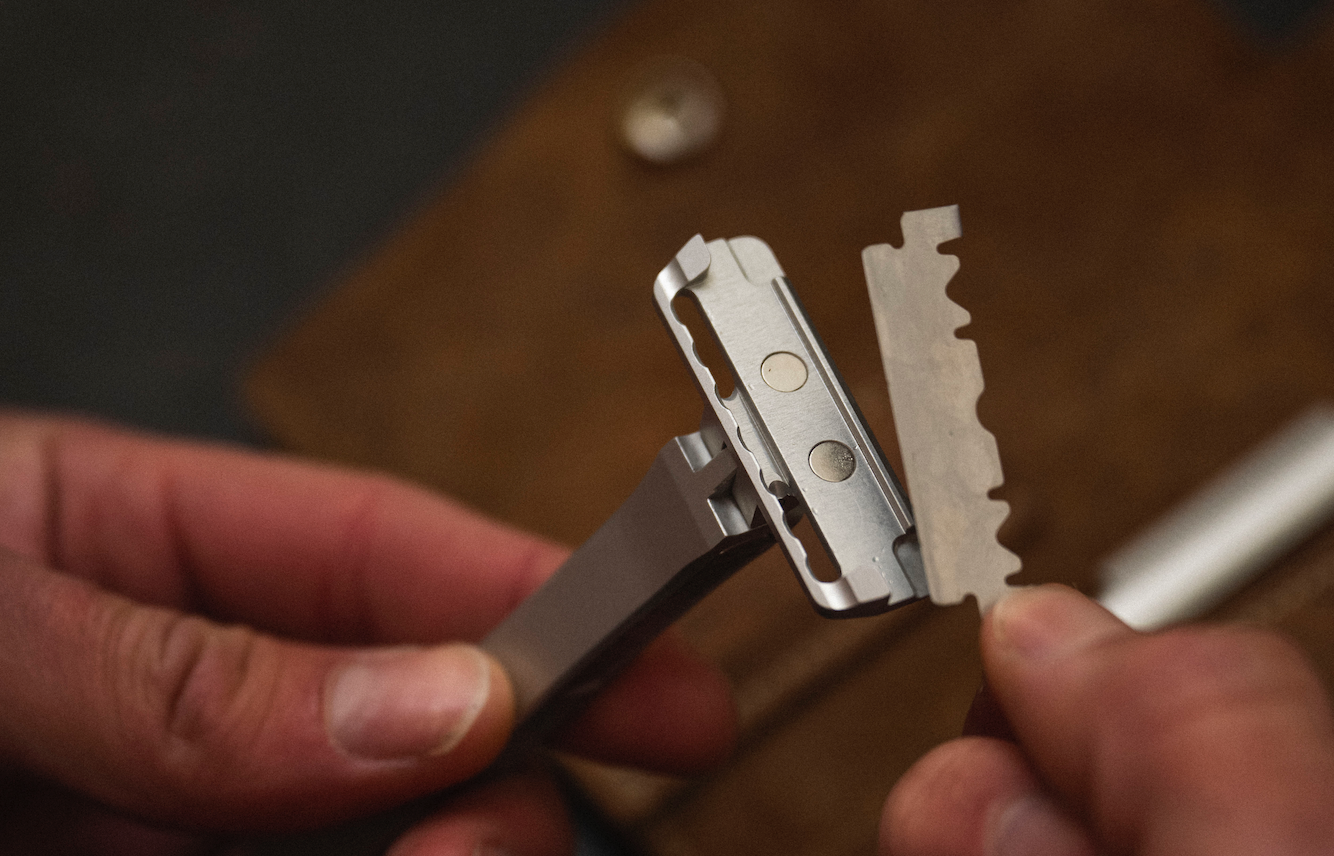
What Happens to a Razor Blade After the Shave?
When we design a new product at Proof, we spend a lot of time thinking about how it's made.
How can we machine it in-house efficiently? Will it last for decades instead of months? Can it be repaired instead of replaced?
But recently we've been asking ourselves another question:
Can we design products that think about the end of their life, too?
For most products, that's a fairly straightforward question. But when your product uses razor blades, things get a little more complicated.
Double-edge razor blades are made from steel, which means they can be recycled. The challenge is that they're also sharp. And while a single blade isn't much to worry about, dozens—or hundreds—of used blades loose in a recycling stream is another story.
So we've been thinking about blade storage, blade disposal, and whether there's a better way to help our customers recycle their blades safely.
Before we talk about potential solutions, we thought we'd share some of the creative ways our customers are already handling used blades.
Common blade disposal methods
Option 1: The Travel Blade Box
One of the most common solutions we've seen is our Travel Blade Box.
Originally designed to hold fresh blades for travel, it also includes a compartment for used blades. Many customers simply drop their spent blades into the used-blade section until it's full.
It's simple, compact, and keeps sharp blades safely contained.
This option still lacks a way to recycled your blades once the used blade compartment is full.

Option 2: The "Two-Tin" Method
David, our co-founder, has a surprisingly simple system.
He keeps one Blade Tin for unused blades and another one for used blades.
When he loads a new blade into his razor, the old blade goes into the second tin. Over time, the used-blade tin fills up while the fresh-blade tin empties.
No new product required—just two blade tins and a little organization.

Option 3: The Blade Blank Method
This might be our favorite one.
A barber, Felipe, drops every used blade into an empty whiskey bottle.
Over time, the bottle fills with hundreds of blades and becomes a surprisingly cool piece of shop decor. More importantly, the blades stay safely contained and completely inaccessible.
It's practical, safe, and honestly looks pretty good sitting on a shelf.

Could We Build Something Better?
The more we looked at these solutions, the more we wondered:
Could Proof create something that makes blade storage easier while also making blade recycling more accessible?
We've been kicking around a few ideas.
Idea #1: A Divided Blade Tin
Our current Blade Tin holds 100 American-made razor blades and costs $30.
What if the tin included a divider?
Unused blades could live on one side. Used blades could live on the other.
Over time, one compartment empties while the other fills. Once every blade has been used, the entire container could potentially be recycled.
We like this idea because it doesn't require customers to purchase another product. The challenge is maintaining a slim margin on a low-cost product and ensuring the tin stays securely closed if it's eventually placed in a recycling stream.
Idea #2: A Dedicated Recycling Tin
Another option is creating a separate blade recycling tin.
Instead of storing fresh and used blades together, the tin would exist specifically for used blades. Perhaps it includes a narrow slot for inserting blades and a mechanism that permanently closes when it's time for disposal or recycling.
The upside is simplicity. The downside is asking customers to purchase and keep track of another container.
Idea #3: A Blade Recycling Program
We've also discussed whether a larger recycling program could make sense.
Instead of recycling blades individually, customers could collect used blades in a safe container and send them back once full. Proof could then recycle them in bulk through a recycling partner equipped to handle sharp metal objects.
We're still researching whether this approach is practical, affordable, and environmentally responsible, but it's an idea we're entrigued by.
Idea #4: Keep Using What Already Exists
The simplest solution may be the one many customers already use.
Store blades in a Travel Blade Box, a blade tin, or another metal container you already have at home. When it's full, transfer the blades into a larger metal container destined for recycling.
No new product. No new manufacturing. Just making use of something that's already in circulation.
There's something appealing about that approach, too.
Help Us Decide
We're still in the idea stage.
Before we design anything, we'd love to hear what you think.
Would you use a divided blade tin? A dedicated recycling tin? A blade recycling program? Or do you think the best solution is simply using containers that already exist?
We've created a short poll below and would appreciate your input.
Let us know how you're handling your blades—and if you have an idea we haven't considered, let us know.
The best products aren't designed in isolation. They're built with the people who use them.